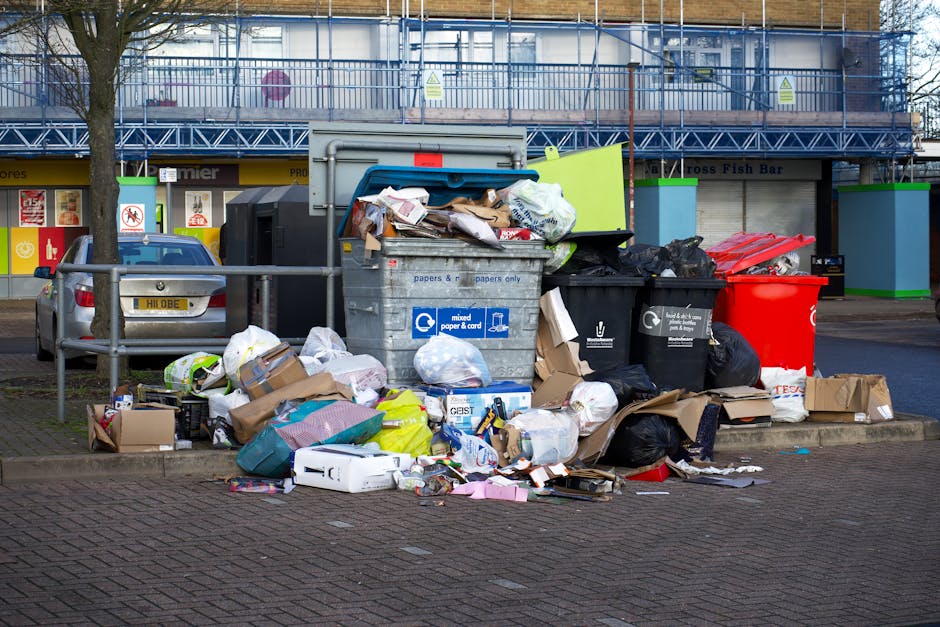
Petticoat Lane Bulky Rubbish Disposal Guide for E1 Traders
If you trade around Petticoat Lane, you already know the rhythm: early deliveries, tight pavements, customers drifting in and out, stock arriving when you least want it, and bulky rubbish somehow appearing at the worst possible moment. Old display units, broken shelves, packaging, damaged stock, worn furniture, and the odd appliance can build up fast. This Petticoat Lane bulky rubbish disposal guide for E1 traders is here to make that part of the job less stressful, more organised, and a lot less likely to trip you up.
The aim is simple. You want bulky waste gone quickly, legally, and without turning your trading day into a mini logistics operation. You also want to avoid the common mistakes that lead to blocked access, fines, wasted time, or items being left behind because nobody quite knew what could go where. Let's face it, nobody wants to be shifting a heavy cabinet out of a narrow frontage at 7:30 in the morning while customers are already queuing.
This guide walks through what bulky rubbish disposal means for E1 traders, how it usually works, what to watch out for, and how to choose the cleanest, most practical route for your business.
Table of Contents
- Why it matters for Petticoat Lane traders
- How the disposal process works
- Key benefits and practical advantages
- Who this is for and when it makes sense
- Step-by-step guidance
- Expert tips for better results
- Common mistakes to avoid
- Tools, resources and recommendations
- Law, compliance and best practice
- Options and comparison table
- Case study or real-world example
- Practical checklist
- Conclusion
- Frequently asked questions
Why Petticoat Lane bulky rubbish disposal guide for E1 traders Matters
Petticoat Lane sits in one of those parts of London where space is precious and timing matters even more. Traders in E1 are often dealing with limited storage, busy footfall, shared access routes, and the need to keep shopfronts looking tidy. Bulky rubbish does not just take up room; it can affect how customers move, how staff work, and how professional your frontage looks. A stack of broken racking by the doorway sends the wrong message very quickly.
There is also the practical side. Bulky waste can be awkward, heavy, and sometimes mixed with other commercial waste. If you leave it too long, it tends to spread. One damaged counter becomes two. A single broken chair somehow turns into a pile of scrap timber, plastic wrapping, and loose fittings. That sort of drift makes clearance more expensive and more disruptive than it needs to be.
For E1 traders, disposal is not simply about getting rid of rubbish. It is about keeping the business presentable, keeping access safe, and making sure waste does not interfere with trading hours. In a busy market environment, those details matter. A lot.
Practical summary: the best bulky rubbish plan is the one that removes waste quickly, fits the access constraints of Petticoat Lane, and avoids turning a simple clearance into a half-day problem.
How Petticoat Lane bulky rubbish disposal guide for E1 traders Works
In real terms, bulky rubbish disposal for local traders usually follows a fairly simple pattern. You identify what needs removing, separate anything sensitive or restricted, decide on the right disposal method, and book a collection or clearance window that works around trading.
That sounds straightforward. In practice, the details make all the difference. Is the waste mixed with packaging and fixtures? Are there metal frames that can be recycled? Are there fridges, electronics, or items that need special handling? Can a vehicle access the frontage without blocking the street for longer than necessary? These are the questions that shape the job.
If you are dealing with general trade waste alongside bulky items, it can help to look at broader business waste removal support so the clear-out is managed as one job rather than several disconnected ones. For larger or heavier items, a dedicated waste removal service is often the cleanest route because it can take mixed bulky loads in one go.
There is also a sorting stage. Some items are suitable for reuse or recycling, while others need direct disposal. A commercial clearance team will usually assess what can be separated before loading, which helps reduce waste and keeps the process tidier. You will notice the difference when the loading area is small and every minute counts.
For traders, timing is everything. Early collections, off-peak windows, and pre-sorted waste all reduce friction. Nobody enjoys juggling a delivery, a collection, and a stream of customers at the same time.
Key Benefits and Practical Advantages
Bulky rubbish disposal is not glamorous, but the benefits are easy to feel once it is done properly. A clear site is easier to run, easier to clean, and easier to sell from. That alone can make the difference between a cramped, stressful trading day and one that feels manageable.
- Better presentation: a clean frontage looks more professional and reassuring to customers.
- Safer access: removing bulky items reduces trip hazards and blocked walkways.
- More usable space: stockrooms, back-of-house areas, and service corridors work better when they are not cluttered.
- Faster turnaround: if items are removed in one planned visit, you avoid repeated interruptions.
- Improved recycling potential: properly sorted waste is easier to divert away from landfill where possible.
- Lower stress for staff: team members are not forced into improvised lifting or last-minute rearranging.
There is also a commercial upside that people sometimes overlook. A tidy unit is easier to reorganise, easier to restock, and easier to adapt if you are changing your display or refitting part of the space. If you have ever stood in a cramped back room wondering where on earth the new stock will go, you will understand why this matters.
For traders clearing out old counters, shelves, or fixtures, it may also be worth looking at furniture disposal or furniture clearance depending on whether the items are single pieces or a larger mixed load. The right option saves time and reduces the chance of leaving awkward leftovers behind.
Who This Is For and When It Makes Sense
This guide is aimed at E1 traders, stallholders, and small business owners who deal with bulky waste in or around Petticoat Lane. That includes retailers, market traders, pop-up operators, cafes with small back rooms, fitting-out teams, and anyone else working with limited urban space.
It makes sense to act when you are facing any of these situations:
- you are replacing shelves, counters, or fixtures;
- you have broken or obsolete stock that cannot simply be bagged up;
- you are closing, relocating, or downsizing a unit;
- you have appliance waste, mixed with general bulky items;
- your stockroom is becoming unsafe or too crowded;
- you need a one-off clearance after a refurb, delivery issue, or seasonal reset.
If the job is more than a couple of heavy items, it is often more efficient to treat it as a proper business clearance rather than trying to piece it together in stages. For traders dealing with workspace tidying or back-office clutter, an office clearance can be a sensible fit. If you are clearing a larger premises, a broader home clearance or house clearance style approach may be useful in mixed-use settings, although commercial requirements still need to be checked carefully.
To be fair, not every trader needs the same level of service. Some just need a quick pickup of one heavy item. Others need a layered removal plan with recycling, access management, and a bit of planning around opening hours. That difference matters.
Step-by-Step Guidance
Here is a practical way to approach bulky rubbish disposal without turning it into a headache.
- List what needs removing. Write down every bulky item, even the awkward smaller bits. One half-broken display unit can hide six smaller problems.
- Separate special waste. Fridges, appliances, hazardous items, and confidential materials should be identified early. Do not leave this to the end.
- Check what can be recycled or reused. Metal, certain timber items, and some furniture can often be diverted more sensibly than general waste.
- Measure access. In Petticoat Lane, access can be the real bottleneck. Measure door widths, corridors, stair turns, and loading space if needed.
- Choose a suitable disposal method. Decide whether you need one-off bulky item removal, a wider clearance, or an ongoing trade waste arrangement.
- Book for the least disruptive time. Early mornings, quieter trading windows, or planned shutdown periods can make the process far smoother.
- Prepare the items. Empty drawers, detach loose shelves, tape sharp edges, and keep the path clear. Small effort, big difference.
- Confirm what is included. Make sure the collection covers labour, loading, and disposal of the full pile. Ambiguity causes arguments later. Nobody wants that.
- Keep documentation. For business waste, retain whatever paperwork or job confirmation is supplied.
- Review the result. Once the waste is gone, quickly inspect the area for fixings, debris, and hidden leftovers.
If you are unsure how bulky items fit with skip loading or partial loads, the page on what can go in a skip can be a useful reference point. And if the load includes appliances, take extra care: fridge and appliance removal is usually better handled as a separate, organised task.
One small but useful habit: photograph the waste before collection if the job is complex. It helps everyone stay aligned. Old-school? Maybe. Effective? Absolutely.
Expert Tips for Better Results
In our experience, the smoothest bulky rubbish jobs are the ones that look boring from the outside. That is a compliment, by the way. Boring waste jobs are usually the well-planned ones.
- Keep one clear collection point. If possible, bring bulky items to a single area before the team arrives. It cuts loading time and prevents confusion.
- Separate metal from mixed waste. It often makes sorting easier and can improve recycling outcomes.
- Avoid overfilling access routes. In a narrow trading street, a small pile can feel bigger than it looks. Leave room for foot traffic.
- Choose a collection day with fewer moving parts. Delivery days and market peaks are not the time for a major clear-out unless you have no choice.
- Ask about safety handling. Heavy lifts, awkward stairs, and glass-fronted fixtures all need sensible planning. Check the provider's insurance and safety approach if the job feels more complex than average.
A good clearance team should also be comfortable discussing recycling and disposal routes in plain language. If they cannot explain what happens to the load after collection, that is a bit of a red flag. Not necessarily a deal-breaker, but worth a pause.
For traders with irregular waste patterns, you might find it helpful to combine bulky clearance with a broader collection plan. The point is not to collect every service under the sun. It is to keep your space operational without constant mess creeping back in.
Common Mistakes to Avoid
A lot of bulky rubbish problems are created by avoidable little missteps. They seem minor at the time. Then the van arrives and the whole thing gets awkward.
- Leaving sorting until collection day: if you have to decide what is hazardous, recyclable, or general waste at the kerbside, the job slows down fast.
- Ignoring access issues: tight turns, low ceilings, shared entrances, and basement stairs all need planning.
- Assuming everything counts as simple rubbish: some items need special handling, especially appliances and anything potentially hazardous.
- Mixing business waste with unrelated items: it can complicate disposal and create compliance questions.
- Booking the wrong service type: a single-item pickup is not the same as a full shop clearance.
- Forgetting paper trail needs: traders should be able to show where waste went if needed.
Another common one: people underestimate the time needed to dismantle bulky fixtures. A cabinet that looks ready to move may still have screws, brackets, cable ties, or damaged fixings hiding underneath. Ten minutes later, you are still there. It happens all the time.
If your clearance includes old shop furniture, seating, or display items, it may be worth comparing options with mattress and sofa disposal or furniture clearance depending on what you actually have. Choosing the right route early can save a lot of back-and-forth.
Tools, Resources and Recommendations
You do not need a warehouse full of equipment to manage bulky rubbish well. A few sensible tools go a long way.
- Measuring tape: for door widths, stair turns, lift access, and the size of bulky items.
- Marker labels: to tag items for reuse, recycling, or disposal.
- Protective gloves: useful when handling rough timber, broken fittings, or dusty fixtures.
- Heavy-duty bags and tape: for smaller bits that travel alongside bulky loads.
- Phone camera: to document the site before and after.
- Basic inventory note: a short list of what is going out keeps everybody honest.
From a planning perspective, there are a few service pages worth knowing about if your clearance includes related items. For example, builders waste clearance can help where a refurbishment has created rubble, timber, or packaging alongside bulky waste. If you are dealing with storage overspill, garage clearance and loft clearance offer a useful model for thinking about awkward, compact spaces.
For business owners who want to line up collection details properly, the pricing and quotes page is a sensible place to start, and book online can be useful when the job needs to move quickly. If you are still weighing up whether removal or disposal is the right fit, the recycling and sustainability information is also worth a look.
Law, Compliance, Standards, or Best Practice
For E1 traders, bulky rubbish disposal is not just a housekeeping issue. It touches on duty of care, health and safety, and responsible waste handling. The exact obligations depend on the type of business, the waste involved, and how the material is stored and transferred. So, while the details vary, the general expectation is straightforward: waste should be handled safely, removed by an appropriate route, and passed to a competent collector or disposal option.
Best practice usually includes:
- keeping waste separated where practical;
- avoiding obstructions on pavements or access routes;
- preventing waste from becoming a fire, trip, or pest risk;
- using a service that can explain how waste is managed after collection;
- retaining any records that show the waste was handled properly.
If the load includes restricted items, hazardous materials, or confidential materials, do not guess. Get the category right first. A small mistake there can become a much larger issue later. For sensitive papers or records, confidential shredding is the more appropriate route than general waste handling.
When safety is a concern, especially with heavy lifting or tricky access, a provider's published health and safety policy can be a useful sign that they take the work seriously. That does not solve everything, obviously, but it does tell you the business has thought about risk rather than improvising on the day.
Options, Methods, or Comparison Table
There is no single correct way to deal with bulky rubbish. The best method depends on volume, item type, access, and how fast you need the space cleared. Here is a simple comparison to help you think it through.
| Method | Best for | Strengths | Trade-offs |
|---|---|---|---|
| One-off bulky item collection | A few large items or a small pile | Fast, simple, minimal disruption | Less suitable for mixed or very large clearances |
| Full business waste clearance | Mixed bulky waste and general trade waste | Efficient, tidy, better for larger jobs | Needs clearer planning and item sorting |
| Appliance-specific removal | Fridges, freezers, and other white goods | Safer handling for specialist items | Not ideal if mixed with unrelated bulky waste |
| Furniture-specific clearance | Counters, chairs, shelving, sofas, desks | Good for grouped items and back-room clear-outs | May not cover every waste type in one visit |
| Builders-style clearance | Fit-outs, refurbishments, strip-outs | Good for mixed heavy waste after work | Overkill for small domestic-style clearances |
If you are trying to decide between a mixed collection and a specialist item removal, think about what is actually taking up space. One fridge is one problem. A fridge plus two damaged counters plus packaging is another story entirely.
Case Study or Real-World Example
A typical Petticoat Lane trader scenario goes like this. A small shop owner is refreshing the front display after a seasonal stock change. Over the years, the old setup has accumulated a broken glass-front cabinet, several heavy shelving sections, a couple of damaged chairs for staff use, and a fridge that stopped working months ago but somehow stayed in the back room. There is also a pile of cardboard and plastic wrap from new stock deliveries.
On paper, none of it looks dramatic. In the shop, though, the clutter is making the back area awkward to move through and the entrance feel cramped. The owner first sorts the items into three groups: furniture, appliance, and mixed packaging. Then they clear a pathway from the back room to the loading point and book a collection for a quieter trading window.
The difference after the removal is immediate. Staff can move without squeezing sideways. The display area feels larger. And the owner no longer has to stare at a half-broken cabinet every time they open the back door. Small relief, but very real.
That is the thing with bulky rubbish. It rarely arrives as one giant crisis. More often it is a slow accumulation that suddenly starts affecting how the business feels. Once it is gone, the change is oddly satisfying.
Practical Checklist
Use this checklist before any bulky rubbish pickup in Petticoat Lane.
- Have I listed every bulky item that needs to go?
- Have I separated appliances, hazardous items, and confidential materials?
- Have I checked whether anything can be reused or recycled?
- Is the access route clear and measured?
- Have I chosen the right type of service for the waste involved?
- Have I picked a collection time that will not clash with trading peaks?
- Are fragile or sharp items wrapped or marked safely?
- Have I kept a record or confirmation of the job?
- Have I removed anything personal, sensitive, or valuable from the area?
- Do I know what will happen to the waste after collection?
If you can tick most of those off, you are already ahead of many rushed clear-outs. And honestly, that little bit of prep tends to pay for itself in calmness alone.
Conclusion
Petticoat Lane trades run on energy, pace, and practical judgement. Bulky rubbish disposal should fit that same pattern: quick, tidy, and well thought through. The best approach is usually the one that matches your waste type, your access conditions, and your trading schedule without creating extra drama. Keep the items sorted, think about safety early, and choose a removal method that suits the real shape of the job, not just the cheapest-looking option.
For E1 traders, that balance matters. It protects your space, keeps the frontage welcoming, and helps you stay focused on customers instead of clutter. If you are planning a clear-out, start small, think clearly, and do not leave the awkward bits until the last minute. That is where most of the hassle lives.
Get a free quote today and see how much you can save.
And if all you needed was a practical nudge to get moving, consider this it. A clearer workspace has a funny way of making the whole day feel lighter.
Frequently Asked Questions
What counts as bulky rubbish for E1 traders?
Bulky rubbish usually means large or awkward items that are too big for standard bins or routine bagged waste collection. For traders, that often includes shelving, counters, chairs, display fixtures, damaged stock, and sometimes appliances or mixed clearance waste.
Can I just leave bulky waste outside my shop in Petticoat Lane?
That is usually not the best idea. Waste left outside can block access, create safety issues, and invite complaints. It is better to arrange a planned pickup so the items are removed promptly and responsibly.
Do I need to sort bulky rubbish before collection?
Yes, ideally. Sorting items into furniture, appliances, general waste, recyclable materials, and anything special or restricted makes the collection smoother and can reduce the chance of items being left behind.
What should I do with old shop furniture?
Old shop furniture can often be handled through furniture clearance or disposal if it is not suitable for reuse. If it is part of a wider business clean-out, it may be better to bundle it into a larger waste removal job.
How do I handle fridges or other appliances?
Appliances should be separated from general waste and handled carefully. If your clearance includes white goods, look at the specific appliance removal route rather than lumping everything together in one unsorted pile.
Is bulky rubbish disposal different from business waste removal?
Yes, often it is. Business waste removal can cover routine waste streams, while bulky rubbish disposal usually focuses on larger physical items that need lifting, loading, and disposal planning. Sometimes the two overlap, which is why a combined service can make sense.
How can I make collection day quicker?
Clear a path, group the items in one place, remove anything sensitive, and keep the route as simple as possible. The less the team has to move things around on arrival, the faster the job usually goes.
What if I have mixed waste after a refurb?
Mixed waste after a refurb is common. In that case, builders waste clearance is often more suitable because it can deal with timber, fittings, packaging, and other leftover materials from fit-out or repair work.
Can I get rid of confidential papers with bulky rubbish?
No, not unless they are handled properly. Confidential documents should be separated and dealt with through confidential shredding so they are not mixed into general waste.
How do I know if a clearance provider takes safety seriously?
Look for clear information about insurance, safe lifting, waste handling, and how the work is managed on site. A detailed health and safety policy is a good sign, although you should still ask questions if anything feels unclear.
What is the best option for a small trader with just a few large items?
For a small number of items, a targeted bulky item collection or a focused furniture disposal service is often the simplest choice. It keeps the job efficient without paying for more capacity than you need.
Where should I start if I am planning a bigger clearance?
Start with a list of items, then check access and timing. After that, compare pricing and quote options so you can match the service to the volume and type of waste. A little planning here saves a surprising amount of hassle later.